
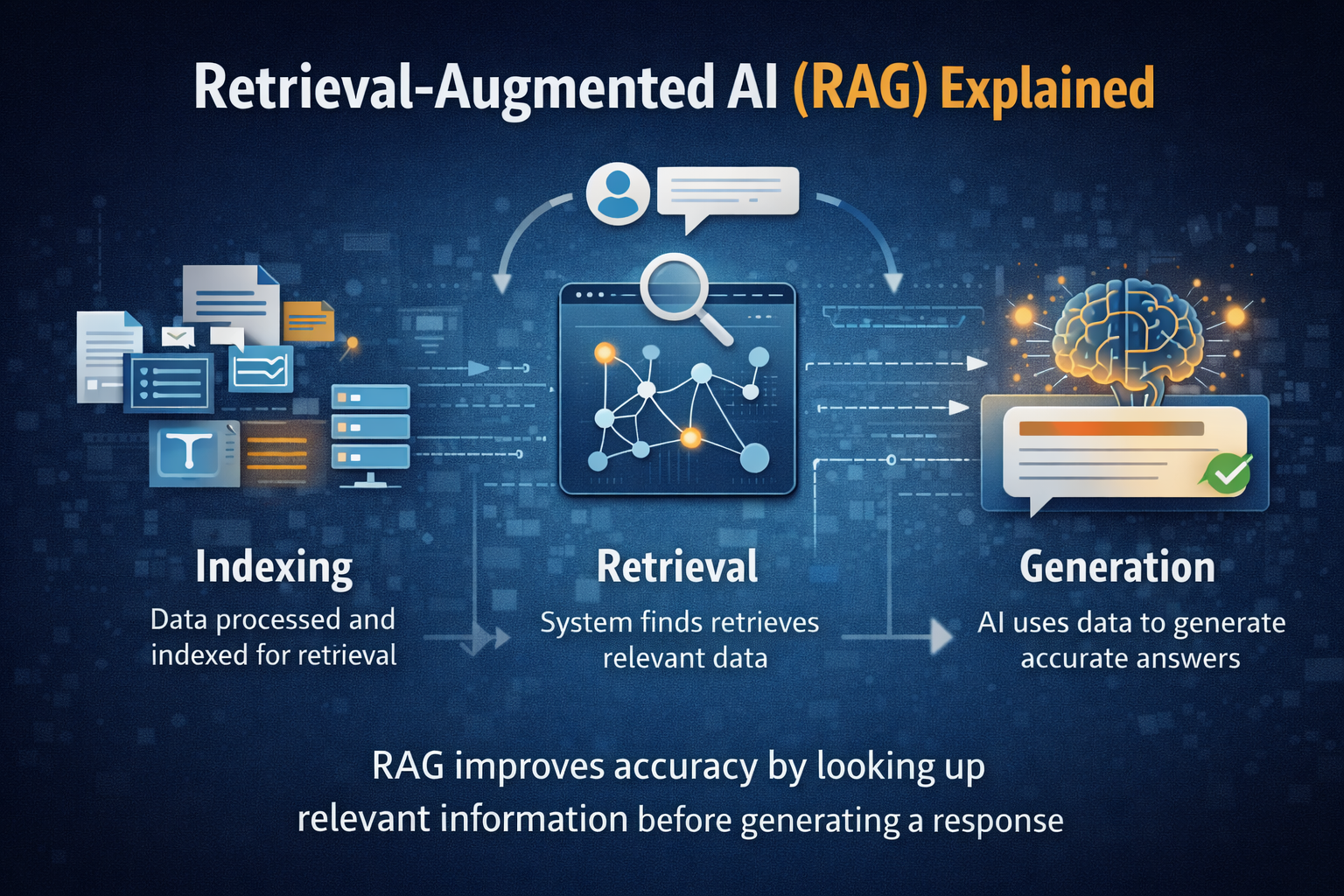
Retrieval-augmented generation (RAG) is an AI approach that improves accuracy by pulling in real-time or external data before generating a response, instead of relying only on what the model was trained on. This makes AI outputs more relevant, up-to-date, and reliable.
Most people hear terms like RAG, retrieval-augmented AI, or vector databases and assume it’s something complicated.
It’s not.
At its core, retrieval-augmented AI solves a very simple problem:
AI doesn’t always know the right answer.
The Problem With Standard AI Models
Most AI models work like this:
- They are trained on massive datasets
- They learn patterns in language
- They generate responses based on that training
But they have limitations:
- They don’t know your specific data
- They can be outdated
- They can “hallucinate” incorrect answers
This happens because traditional models rely on static training data.
What Retrieval-Augmented AI Actually Does
Retrieval-augmented AI changes the process.
Instead of answering immediately, it:
- Searches for relevant information
- Pulls data from external sources (documents, databases, APIs)
- Uses that data to generate a response
In simple terms:
It looks things up before it answers.
This combination of retrieval + generation improves both accuracy and relevance.
A Simple Example
Without RAG:
“What’s our company refund policy?”
AI might guess—or be wrong.
With RAG:
- It searches your actual policy documents
- Pulls the correct section
- Generates an answer based on real data
Now the answer is:
- Accurate
- Verifiable
- Context-specific
Why Retrieval-Augmented AI Matters
This is where things get important.
RAG is one of the most practical ways to make AI usable in real business environments.
1. Reduces Hallucinations
AI models can generate incorrect information confidently.
RAG reduces this by grounding responses in real data.
2. Keeps Information Up to Date
Instead of retraining models constantly, you can:
- Update your data source
- Let AI retrieve the latest information
This makes systems far more maintainable.
3. Makes AI Context-Aware
RAG allows AI to:
- Use internal company data
- Reference documentation
- Answer domain-specific questions
This is critical for:
- Support systems
- Internal tools
- Knowledge bases
4. Enables Real Business Applications
This is where RAG shines:
- Customer support assistants
- Internal knowledge systems
- Training tools (👀 your restaurant app)
- Document search and analysis
Companies are already using RAG to connect AI with internal knowledge systems and improve decision-making.
How RAG Works (Without the Jargon)
A basic RAG system has three parts:
1. Indexing
Your data is:
- Processed
- Converted into embeddings
- Stored in a searchable format
2. Retrieval
When a question is asked:
- The system searches for relevant content
- Finds the most useful pieces of data
3. Generation
The AI:
- Combines the retrieved data
- Generates a final answer
This pipeline allows AI to move from guessing → grounded responses.
Where RAG Fits Into Modern AI Systems
RAG is quickly becoming the standard for:
- AI assistants
- Chatbots
- Enterprise AI tools
Because it turns AI from:
❌ A general-purpose guesser
➡️
✅ A context-aware system connected to real data
What RAG Is Not
To understand it clearly, it helps to know what it isn’t:
- It’s not just a chatbot
- It’s not just search
- It’s not fine-tuning
It’s a system that combines search + AI generation.
The Real Shift
RAG represents a bigger shift in how AI is used:
From:
- Static knowledge
To:
- Dynamic, real-time information
From:
- Generic answers
To:
- Context-specific intelligence
This is why most serious AI applications today include some form of retrieval.
Final Thoughts
Retrieval-augmented AI isn’t just a technical concept.
It’s a practical solution to one of AI’s biggest problems:
accuracy.
If you’re building anything with AI—tools, workflows, training systems, or internal apps—
You’re probably going to use RAG.
Whether you realize it yet or not.
FAQ
What is retrieval-augmented generation (RAG)?
Retrieval-augmented generation is an AI technique that retrieves relevant information from external data sources before generating a response, improving accuracy and relevance.
Why is RAG important in AI?
RAG improves AI reliability by reducing hallucinations, keeping responses up to date, and enabling models to use real-world data.
How is RAG different from traditional AI?
Traditional AI relies only on training data, while RAG pulls in external data at runtime to generate more accurate answers.
What are common use cases for RAG?
- Customer support systems
- Internal knowledge bases
- AI training platforms
- Document search tools
Does RAG replace fine-tuning?
No. RAG and fine-tuning solve different problems. RAG adds real-time data access, while fine-tuning adjusts model behavior.