
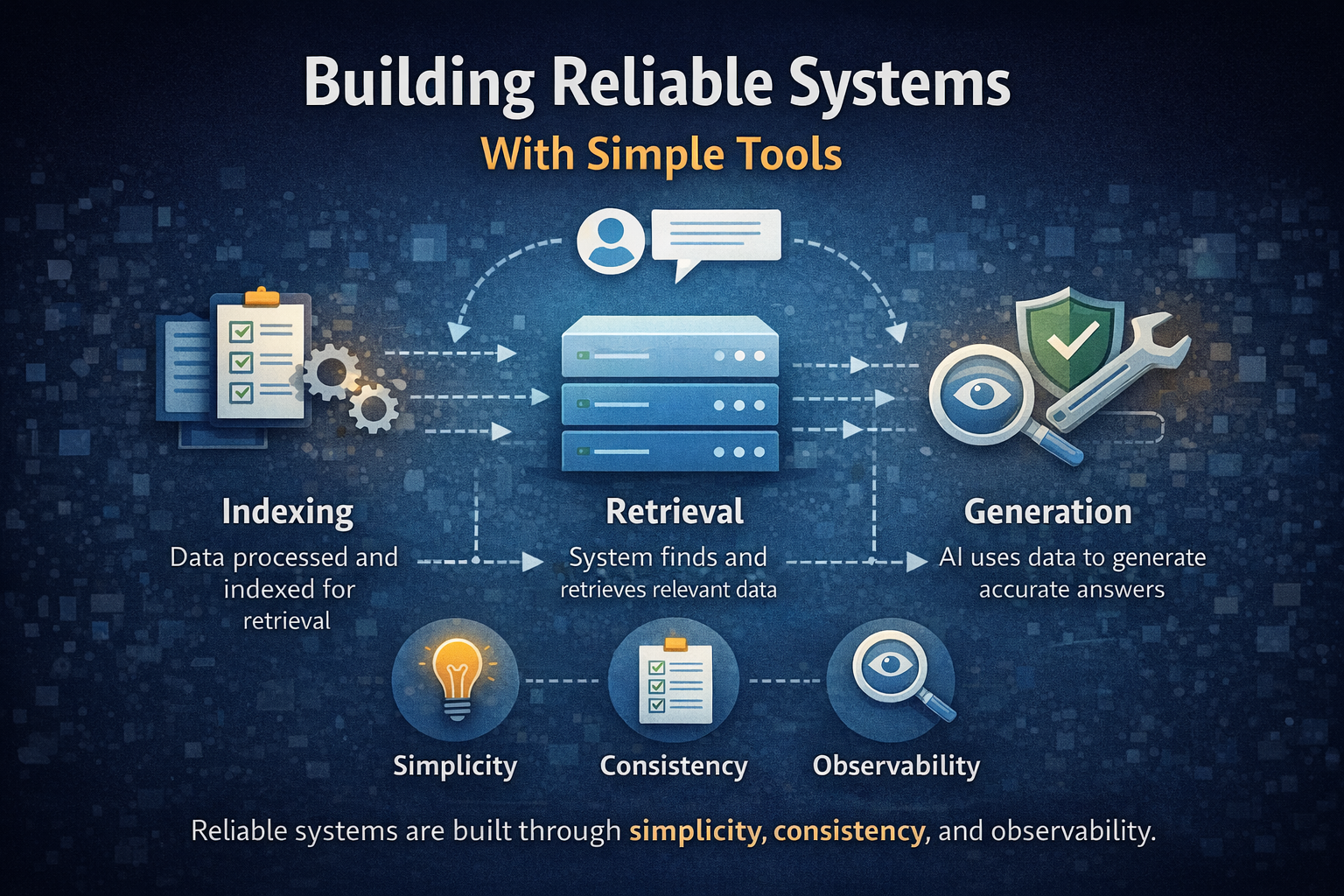
Reliable systems are built through simplicity, consistency, and observability—not complexity. Using simple, well-understood tools often leads to more stable, maintainable, and scalable systems than relying on overly complex architectures.
There’s a common assumption in software development:
More complex tools = more reliable systems
In practice, the opposite is often true.
The most reliable systems are usually built with:
- Simple tools
- Clear workflows
- Well-understood components
Not massive stacks of unnecessary complexity.
What Makes a System Reliable?
Reliability means a system:
- Works consistently
- Handles failures gracefully
- Recovers quickly
- Performs under expected conditions
In engineering terms, reliability is the probability that a system performs its intended function without failure over time.
But in real-world development, reliability comes down to something simpler:
Can you trust it to work when you need it?
Why Complexity Reduces Reliability
Complex systems introduce more:
- Points of failure
- Dependencies
- Unknown interactions
Every additional layer increases risk.
This is why many engineering principles emphasize simplicity—because simpler systems are easier to understand, debug, and maintain.
The Case for Simple Tools
Simple tools have advantages that are often overlooked:
✅ Easier to Understand
You know how they work—and why they fail.
✅ Faster to Debug
Less abstraction means faster troubleshooting.
✅ More Predictable
Fewer moving parts = fewer surprises.
✅ Easier to Maintain
You’re not dependent on complex ecosystems.
This aligns with long-standing engineering principles like the Unix philosophy, which emphasizes building small, modular, and composable systems.
Reliability Comes From Systems, Not Tools
Tools don’t create reliability.
Systems do.
You can build a fragile system with the best tools—and a reliable one with basic tools.
What matters is:
- How components interact
- How failures are handled
- How visibility is maintained
Core Principles for Building Reliable Systems
1. Start Simple
Don’t over-engineer.
Use the simplest solution that solves the problem.
This aligns with modern development practices where simplicity is considered essential to effective system design.
2. Design for Failure
Everything breaks eventually.
Reliable systems assume failure and plan for it:
- Retry mechanisms
- Fallback systems
- Graceful degradation
3. Add Observability Early
You can’t fix what you can’t see.
Reliable systems include:
- Logging
- Monitoring
- Alerts
Observability allows you to detect and respond to issues before they become incidents.
4. Reduce Dependencies
Every dependency is a risk.
Fewer external services and integrations means:
- Fewer failure points
- More control
- Easier debugging
5. Automate the Right Things
Automation increases reliability when used correctly:
- Backups
- Health checks
- Deployments
But automation should be simple and transparent—not opaque.
Simple vs Complex: A Real-World Example
Over-Engineered System
- Multiple microservices
- Complex orchestration
- Heavy infrastructure
Result:
- Hard to debug
- Difficult to maintain
- Fragile under failure
Simple System
- Fewer components
- Clear data flow
- Minimal dependencies
Result:
- Easier to understand
- Faster to fix
- More reliable over time
The Hidden Cost of “Advanced” Tools
Advanced tools often come with:
- Steep learning curves
- Hidden failure modes
- Dependency on external systems
- Increased operational overhead
You’re not just adopting a tool.
You’re adopting:
- Its complexity
- Its assumptions
- Its failure modes
Reliability Is Built Through Iteration
Reliable systems aren’t built all at once.
They evolve.
Modern engineering practices emphasize:
- Iteration
- Testing
- Continuous improvement
This is why many teams build systems incrementally and improve them over time rather than trying to design perfect systems upfront.
Where Simple Tools Shine
Simple tools work best when:
- You understand the problem clearly
- The system needs to be stable
- The team needs to move quickly
- Debugging speed matters
They are especially effective in:
- Web platforms
- Internal tools
- Monitoring systems
- AI-assisted workflows
The Bigger Shift
There’s a shift happening in how systems are built:
From:
- Tool-driven complexity
To:
- System-driven simplicity
From:
- “What’s the most advanced stack?”
To:
- “What’s the most reliable solution?”
Final Thoughts
Reliable systems don’t come from complexity.
They come from:
- Clarity
- Simplicity
- Good design decisions
The goal isn’t to use the most powerful tools.
It’s to build something that works—consistently.
FAQ
What makes a system reliable?
A reliable system consistently performs its intended function, handles failures gracefully, and maintains stability over time.
Are simple systems more reliable than complex ones?
Yes. Simpler systems are generally more reliable because they have fewer dependencies, fewer failure points, and are easier to debug and maintain.
Why do complex systems fail more often?
Complex systems introduce more dependencies and interactions, increasing the likelihood of unexpected failures and making issues harder to diagnose.
What are examples of simple tools for reliable systems?
- Basic monitoring tools
- Logging systems
- Lightweight APIs
- Simple deployment pipelines
How do you improve system reliability?
- Reduce complexity
- Add observability
- Design for failure
- Iterate and improve over time