
Originally developed in April 2025 | Updated October 2026
What if you could build an intelligent, solar-powered communications network that operates without traditional internet infrastructure?
Imagine being deep in the wilderness, responding to a natural disaster, conducting a remote research expedition, or participating in a field training exercise. Cellular coverage is unavailable, Wi-Fi is nonexistent, and conventional infrastructure is miles away.
But your team can still exchange messages, share GPS coordinates, access offline reference materials, and potentially receive assistance from a locally hosted AI system.
That vision inspired SolarSentinel, an open-source experimental project I started developing to explore the intersection of artificial intelligence, renewable energy, decentralized networking, and off-grid communications.
SolarSentinel is designed around one fundamental idea:
Operate Beyond the Grid. Adapt Beyond the Mission.
What Is SolarSentinel?
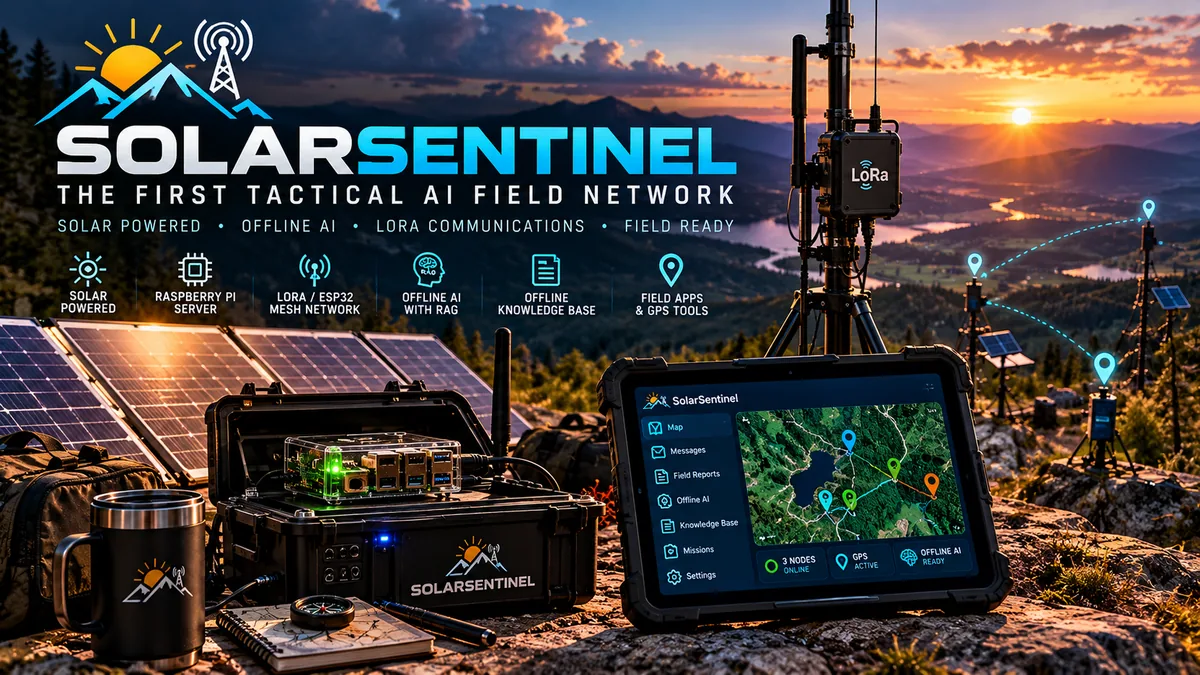
SolarSentinel is an experimental, modular field-network concept that combines portable computing, solar energy, wireless communication, and locally hosted artificial intelligence.
Unlike conventional cloud-connected applications, the goal is to create an infrastructure that can perform useful tasks even when access to the public internet is unavailable.
The architecture brings together several technologies:
- Raspberry Pi: A portable server acting as the network’s central computing and information hub.
- ESP32 Microcontrollers: Low-power devices capable of collecting data and communicating with other nodes.
- LoRa Wireless Networking: Long-range, low-bandwidth communications for messages, location updates, and field reports.
- Amateur Radio: Potential supplementary packet-radio communication capabilities.
- Solar Power and Battery Storage: Renewable energy systems designed to support operations away from conventional power sources.
- Ollama and Retrieval-Augmented Generation (RAG): A proposed local AI layer for processing and retrieving operational information.
- Kiwix Offline Knowledge Libraries: Locally accessible documentation and reference materials.
- Progressive Web Applications (PWAs): Mobile-friendly interfaces for participating in field operations.
The goal is not simply to build another messaging application. It is to explore the foundations of a portable, intelligent computing and communications ecosystem.
Why Build an Offline AI Network?
Modern computing has become incredibly powerful, but much of that capability depends on external services.
Most AI applications require internet access, remote servers, and centralized infrastructure. Many communications tools have similar dependencies.
Those requirements create challenges in environments where connectivity is unreliable or unavailable.
SolarSentinel explores an alternative: local-first computing.
By combining portable servers, decentralized communications, and self-hosted software, an offline field network could potentially provide several valuable capabilities.
1. Communications Without Conventional Internet
A field network could support short text messages, waypoint information, equipment updates, and status reports over suitable radio links.
LoRa is particularly interesting because it supports relatively long-distance communication with modest power requirements.
However, radio coverage depends on terrain, antennas, interference, transmission power, and applicable regulations. A LoRa network is not equivalent to cellular broadband.
2. Offline Access to Knowledge
A Raspberry Pi or similar device could host local reference materials through tools such as Kiwix.
Depending on storage capacity, users could access educational documents, technical manuals, environmental references, and other stored resources without an active internet connection.
3. Locally Hosted Artificial Intelligence
A local language model could help organize notes, search approved documentation, and summarize information collected from the field.
This is where SolarSentinel’s proposed RAG architecture becomes especially interesting.
4. Renewable Energy
Solar charging and battery storage could help support field equipment in locations without easy access to electrical outlets.
Actual operating time would depend on power consumption, battery capacity, available sunlight, and hardware efficiency.
The Hardware: Raspberry Pi, ESP32, and Solar Power
The core SolarSentinel design centers around a portable Raspberry Pi server.
The Raspberry Pi would serve as a local computing hub, providing access to applications, stored information, and connected hardware.
Additional nodes based on ESP32 microcontrollers could collect sensor data, relay messages through supported communications links, and contribute location or status information.
Solar-Powered Operations
The project’s hardware documentation outlines a power system consisting of:
- Solar panels for collecting energy.
- A charge controller for managing battery charging.
- LiFePO4 battery storage.
- Voltage conversion for supplying appropriate power to computing hardware.
- Raspberry Pi and connected peripheral devices.
This approach is intended to support portable deployments in outdoor environments.
The repository contains hardware recommendations and setup documentation, although real-world endurance and performance would require testing with a specific hardware configuration.
LoRa and Radio Communications
One of the major challenges in designing an off-grid network is exchanging information between physically separated devices.
SolarSentinel explores LoRa as a potential communications layer.
LoRa is a low-power radio technology designed for relatively small data transmissions. It is commonly associated with sensor networks and Internet of Things applications.
For SolarSentinel, I explored using it to exchange information such as GPS coordinates, waypoint updates, short text messages, and equipment status.
The project also includes architectural documentation for bulletin-board-style messaging and potential amateur-radio packet communications.
An important distinction is that these technologies have different capabilities and legal requirements. Amateur-radio operation must comply with licensing, identification, and transmission rules, including restrictions on obscured communications.
The project’s radio components are experimental designs, not a validated emergency communications system.
Integrating Local AI with Ollama and RAG
One of my favorite aspects of SolarSentinel is the possibility of connecting local AI to field data.
Instead of relying on a cloud-hosted chatbot, the concept explores running compatible models on locally controlled hardware.
Ollama provides one possible foundation for that approach.
However, the Raspberry Pi’s hardware specifications and the selected AI model would determine whether local inference is practical and how well it performs.
What Would the AI Actually Do?
The project’s RAG system plan explores several potential functions.
Field report summarization: Organize collected observations into readable summaries.
GPS and waypoint assistance: Retrieve stored location information and help users review recorded waypoints.
Equipment monitoring: Interpret recorded power-system measurements or network-health information.
Offline document retrieval: Search locally stored manuals, reference materials, and approved knowledge sources.
Operational knowledge assistance: Answer questions using relevant retrieved information instead of depending exclusively on a model’s training data.
Retrieval-Augmented Generation is especially useful as an architectural concept because it allows responses to incorporate contextual information from external knowledge sources.
It does not guarantee correctness, though, and AI-generated recommendations would require appropriate validation and human oversight.
The current GitHub repository includes planning documents for this architecture rather than a fully integrated and tested RAG deployment.
A Progressive Web App for Mobile Field Nodes
Another design goal was making SolarSentinel accessible through smartphones.
Instead of requiring every participant to carry specialized hardware, a progressive web application could provide a lightweight interface for interacting with the system.
The planned SolarSentinel PWA includes concepts for:
- Recording GPS coordinates and waypoints.
- Viewing field assignments and mission information.
- Submitting observations and status reports.
- Storing selected information locally.
- Synchronizing information when connectivity becomes available.
- Interfacing with compatible local network or external radio gateways.
A PWA could make the system easier to deploy across different devices.
Certain capabilities, including Bluetooth support, background synchronization, and hardware communication, depend on the device, operating system, and browser.
Those constraints would need to be addressed as part of a working implementation.
From Field Communications to Training Simulations
SolarSentinel also expanded into an interesting area: mission-based training and simulation.
The repository includes scenario files and concepts for modular mission engines.
I explored how a connected field system might support simulated rescue exercises, navigation challenges, outdoor training, and cooperative role-playing scenarios.
The longer-term concept included procedural mission generation, configurable assignments, and potentially augmented-reality experiences.
For example, a group participating in a training exercise might receive simulated field instructions, document observations, and submit location-based progress reports.
These are development concepts rather than finished production features.
They also provide opportunities to explore the intersection of embedded computing, mobile applications, game systems, and AI.
Exploring a More Resilient Computing Architecture
What interests me most about SolarSentinel is how the individual components can work toward a broader architectural goal.
A conventional application often assumes that connectivity is always available.
An offline-first system forces developers to think differently.
How should information be stored when the connection disappears?
How can devices exchange useful data over a constrained network?
What happens when individual nodes become unavailable?
How should a user interface behave when it cannot contact a central server?
And how can useful AI capabilities be delivered while keeping data under local control?
These are engineering questions that extend far beyond wilderness communications.
They apply to industrial environments, environmental monitoring, private AI deployments, remote infrastructure, and other settings where reliability and local control matter.
SolarSentinel’s Current Development Status
SolarSentinel remains an experimental, open-source project.
Its repository includes a combination of working code foundations, firmware examples, configuration files, hardware guidance, architectural documentation, and future development proposals.
Among the materials available are:
- ESP32 firmware examples.
- Raspberry Pi deployment scripts.
- Solar power configuration guidance.
- LoRa networking plans.
- Local AI and RAG architecture documentation.
- Offline knowledge-base setup guides.
- Progressive web app specifications.
- Field mission examples and scenario files.
The project should not be considered a complete, production-ready communications network or a certified emergency-response solution.
Instead, it represents a technical exploration of how these technologies could eventually be brought together.
What’s Next for SolarSentinel?
If I continue developing SolarSentinel as a standalone system, several areas would be logical priorities.
First would be establishing a repeatable Raspberry Pi deployment with reliable local access and system monitoring.
Next would be testing communications between physical ESP32 and LoRa nodes under realistic field conditions.
From there, I would focus on a working offline-first mobile interface with local storage and synchronization.
The AI component would come after a dependable foundation was established, beginning with narrow, well-defined tasks and verifiable information sources.
Finally, I would want to evaluate real-world power consumption, connectivity performance, security, usability, and resilience through structured field testing.
These steps would help turn the architecture from an interesting experiment into something measurable and repeatable.
Explore the SolarSentinel Project on GitHub
SolarSentinel’s documentation and experimental code are currently available in my public RAG AI Specialist GitHub repository.
GitHub Repository:
https://github.com/CptNope/Rag-AI-Specialist
The relevant folders include:
/hardware/— Power systems and hardware documentation./firmware/— Embedded device examples./lora/— LoRa networking architecture./radio/— Radio integration plans./ai/— Local AI and retrieval system concepts./pwa/— Mobile field application specifications./scenarios/— Mission and training examples.
If you’re interested in decentralized computing, embedded hardware, local AI, or off-grid networking, feel free to explore the repository and contribute ideas.
Final Thoughts: Operate Beyond the Grid
SolarSentinel started with an ambitious idea: combining intelligent software with resilient, independent infrastructure.
The result is an ongoing collection of experiments exploring how renewable energy, wireless networking, AI, and portable computing might work together.
What I enjoy most about projects like this is that they challenge conventional assumptions about how software should operate.
Not every intelligent application needs a permanent cloud connection.
Not every communications system needs to rely entirely on centralized infrastructure.
And sometimes the most interesting development opportunities emerge when you begin with a practical constraint and explore what’s possible.
Operate Beyond the Grid. Adapt Beyond the Mission.
About the Author
I’m Jeremy Anderson, a software developer, cybersecurity specialist, and AI consultant with a passion for building practical solutions using emerging technologies.
Through Jeremy Anderson Tech, I explore artificial intelligence, cybersecurity, embedded systems, automation, and custom software development.