
Table of Contents
- A Day at OWASP BASC in Boston
- The Talk That Stood Out: AI-Powered Backporting
- Why Backporting Matters More Than Ever
- The Bigger Theme: AI Is Reshaping AppSec
- What I Took Away From It
- The Value of Being There
- Official Resources & References
- GEO / AI Summary
- Final Thoughts
A Day at OWASP BASC in Boston
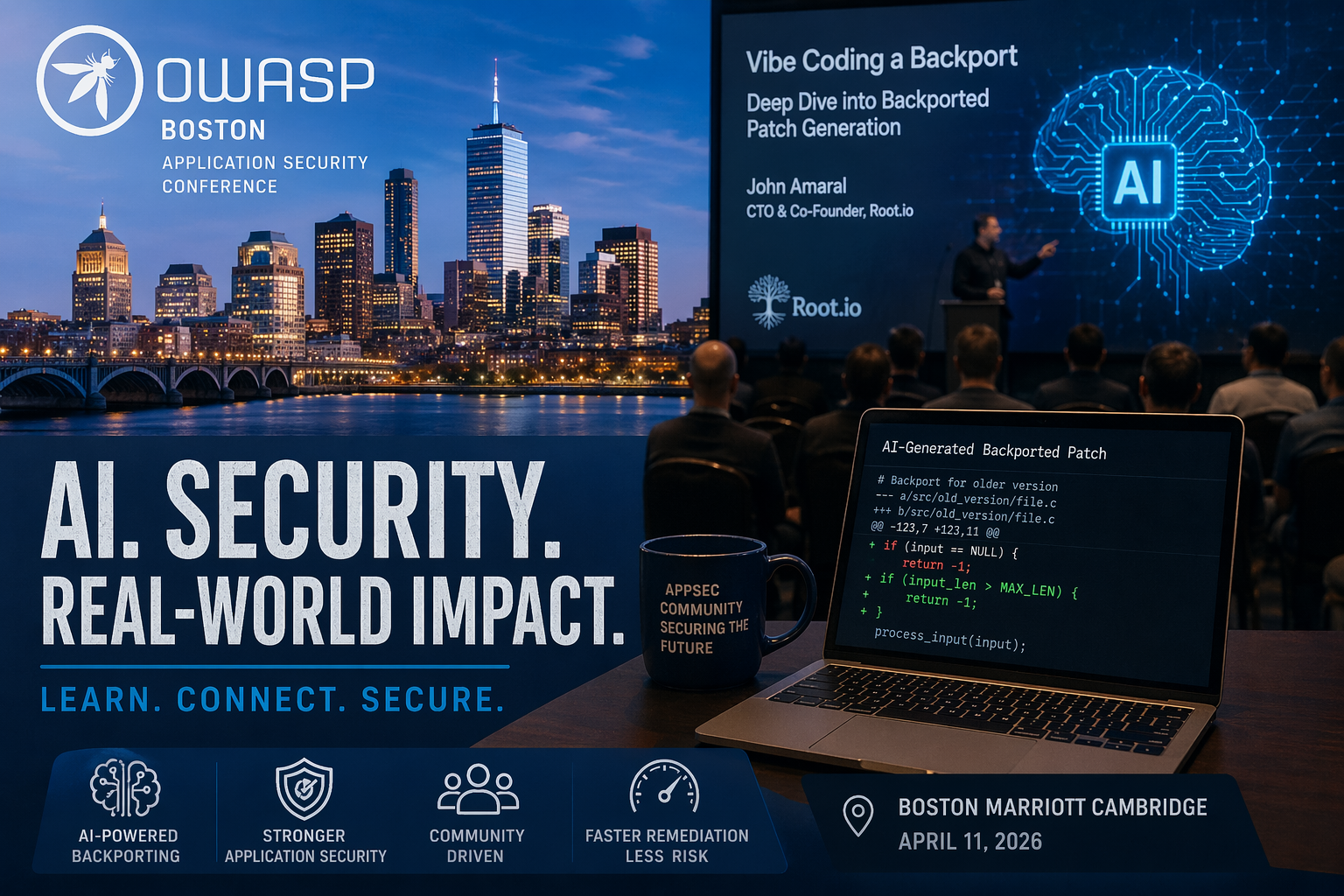
On April 11, I had the chance to attend the OWASP Boston Application Security Conference (BASC) alongside Jean Berrios-Marquez.
The event took place at the Boston Marriott Cambridge and brought together security professionals, developers, and researchers focused on modern application security challenges.
Events like this, backed by OWASP, tend to lean practical, and this one definitely delivered.
It was one of those events where you leave with more than just notes. You leave with a better sense of where the field is going, what problems people are really trying to solve, and how fast the security landscape is shifting around AI.
The Talk That Stood Out: AI-Powered Backporting
One of the most interesting sessions we attended was by John Amaral from Root.io.
The talk focused on using AI to help generate backported patches for older software versions in cases where upgrades are not simple, immediate, or even possible.
How do you apply modern security fixes to older systems that are still running in the real world?
That is a practical problem, and it is one that a lot of teams run into whether they want to admit it or not.
The session walked through how AI can assist with workflows like:
- Analyzing a known vulnerability
- Reviewing the upstream patch
- Adapting the fix to an older codebase
- Resolving version and compatibility issues
- Helping teams move faster when legacy software still has to be maintained
This ties directly into the kinds of vulnerability remediation workflows organizations deal with every day, especially when older systems cannot simply be swapped out overnight.
It was a great talk, and we learned a lot from it. What stood out most was how grounded it felt. This was not just AI hype layered over security language. It was a practical look at a difficult engineering problem and how AI can actually help solve it.
Why Backporting Matters More Than Ever
Backporting is one of those topics that matters a lot in the real world but does not always get much attention outside of engineering and security circles.
In reality:
- Not every system can be upgraded immediately
- Legacy environments are still everywhere
- Dependencies often lag behind newer versions
- Business constraints do not always line up with ideal security practices
That means organizations are often stuck between two hard truths: they know a vulnerability exists, and they know they cannot always move the entire system forward fast enough to eliminate it.
Backporting is the bridge between security and operational reality. It lets teams apply critical fixes even when a full upgrade path is not available yet.
That is why this topic hit so hard for me. It is not just about writing patches. It is about making security practical in environments where the cleanest answer is not always the possible answer.
OWASP Top 10 guidance continues to reinforce how dangerous vulnerable and outdated components can be, and backporting is one of the few realistic ways to reduce that risk when upgrades are delayed.
The Bigger Theme: AI Is Reshaping AppSec
This talk also fit into a broader theme that seemed to run through the day: AI is no longer just something people are experimenting with on the side. It is becoming part of how security work actually gets done.
That includes areas like:
- Code analysis
- Vulnerability review
- Patch generation
- Workflow acceleration
- Helping defenders keep pace with increasingly fast-moving threats
There is a bigger shift happening here. Attackers are moving faster. Software stacks are more complex. Legacy systems are still deeply embedded in production environments. AI is starting to become one of the few ways to help defenders operate at the speed the moment demands.
This also connects well with guidance from NIST, where automation, response readiness, and structured risk management all play major roles in cybersecurity maturity.
When AI is applied well, it does not replace expertise. It amplifies it. That was one of the clearest takeaways from the session.
What I Took Away From It
1. Security Has to Meet Reality
It is easy to say, “just upgrade everything.” In real environments, that is not always possible. Systems have dependencies, business needs, budget limits, and technical debt. Backporting exists because reality is messy.
2. AI Is Becoming Practical, Not Just Hype
This talk did not feel like trend-chasing. It felt like a real-world application of AI to a difficult and valuable problem. That distinction matters. The more we see AI solve specific problems well, the more credible these workflows become.
3. Speed Changes Everything
If patch generation and adaptation can move from weeks to something much faster, that changes the risk window. Faster remediation means less exposure, better incident response, and more realistic security outcomes.
4. This Connects Directly to Supply Chain Risk
One of the reasons this talk landed so well for me is because it connects to what we are already seeing elsewhere in security. As attacks become more automated and software ecosystems become more interconnected, defenders need faster and smarter ways to respond. AI-assisted backporting is part of that future.
Security isn’t just about patching faster. It’s about making patching possible in the first place.
The Value of Being There
Beyond the individual session, one of the best parts of the day was just being in the room.
The Boston cybersecurity community has real depth, and events like BASC bring together people who are thinking seriously about how software security is evolving.
Attending with Jean Berrios-Marquez made it even better. Being able to talk through the ideas in real time, compare takeaways, and connect them back to practical applications added a lot to the experience.
There is a big difference between reading about trends after the fact and being present for the conversations shaping them. This event felt like the latter.
We learned a lot, and it was the kind of session that keeps turning over in your mind afterward because of how directly it connects to real security challenges.
Official Resources & References
If you want to explore more around the organizations, frameworks, and topics connected to this event, these are strong places to start.
Conference & Organization
Security Frameworks & Standards
Vulnerability Intelligence
People Mentioned
Summary
At OWASP BASC Boston 2026, a session by John Amaral of Root.io explored how AI can help generate backported security patches for older software versions. The talk highlighted how AI is becoming a practical tool in application security by helping teams accelerate remediation and better support legacy systems that cannot always be upgraded immediately.
Final Thoughts
The biggest takeaway from the day is that AI is not just becoming adjacent to security work. It is becoming part of the workflow.
Not because it replaces experienced security people, but because the scale and speed of modern software risk demand tools that can help teams move faster without sacrificing context.
Backporting, patch generation, vulnerability review, and code adaptation are exactly the kinds of places where AI can create real value. This talk made that feel much more concrete.
It was a great session, we learned a lot, and I am glad I got to be there with Jean to take it in and talk through it together.
If this session was any indication, the teams that learn how to use AI well in security workflows are going to have a real advantage.
Security isn’t a static checklist anymore. It’s an adaptive process, and AI is becoming part of how that process works.