
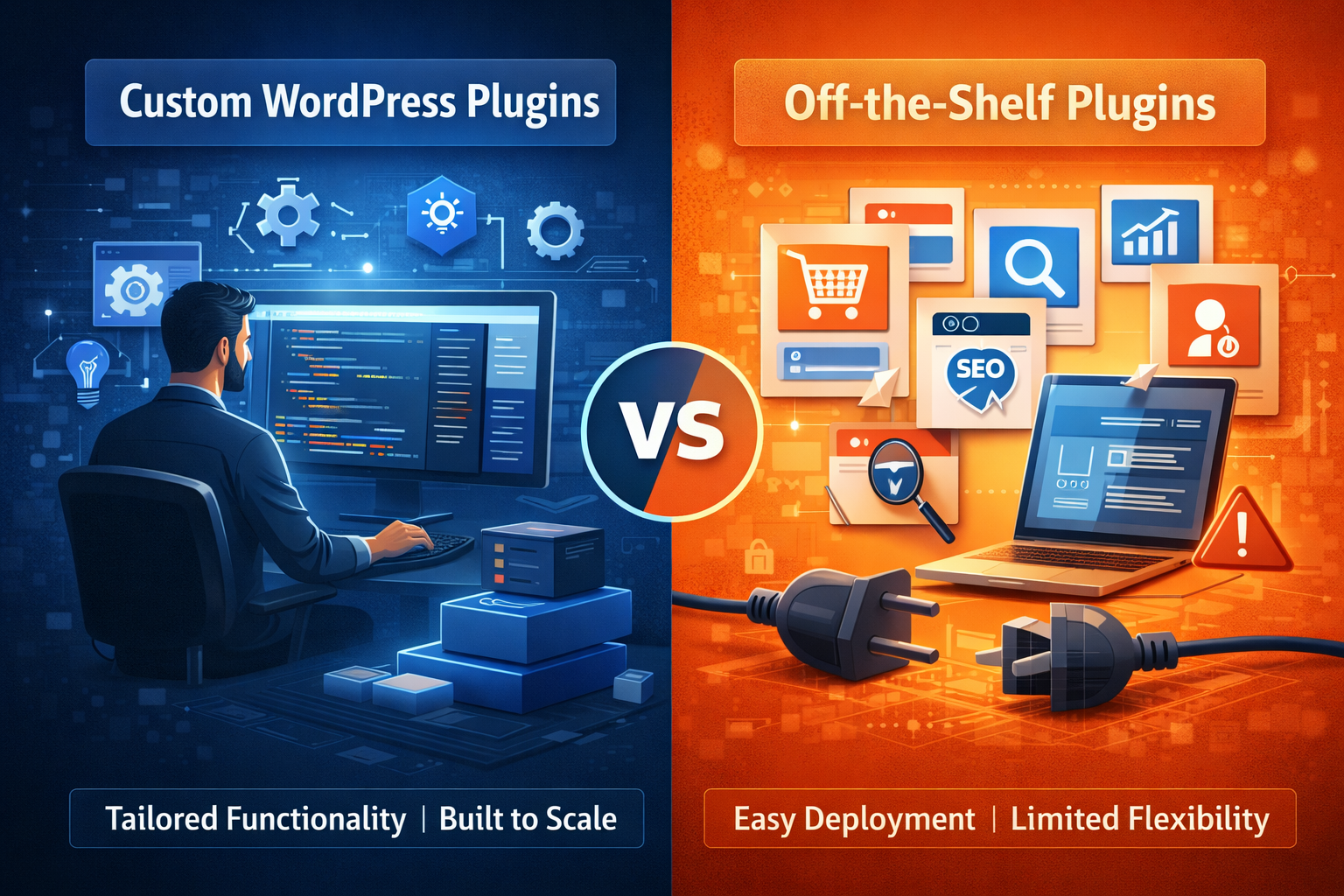
Custom WordPress plugins are best for businesses that need performance, scalability, and tailored functionality, while off-the-shelf plugins are ideal for quick deployment and standard features. The right choice depends on complexity, budget, and long-term goals.
Choosing between custom WordPress plugins and off-the-shelf solutions is one of the most important decisions you’ll make when building or scaling a website.
At first, plugins seem like the obvious answer.
Need a feature? Install a plugin.
But as your site grows, that decision starts to matter a lot more.
What Are Off-the-Shelf WordPress Plugins?
Off-the-shelf plugins are pre-built tools available in the WordPress plugin marketplace.
They’re designed to solve common problems:
- Forms
- SEO
- eCommerce
- Membership systems
The appeal is simple:
- Fast setup
- Low upfront cost
- No development required
For many projects, this is the right starting point.
The Benefits of Off-the-Shelf Plugins
Off-the-shelf plugins are popular for a reason.
✅ Fast to Deploy
You can install and activate features in minutes.
✅ Cost-Effective
Many plugins are free or relatively inexpensive.
✅ Community Support
Popular plugins are widely used and documented.
The Limitations of Off-the-Shelf Plugins
As projects grow, the downsides become more apparent.
❌ Feature Bloat
Many plugins include far more functionality than you need, which can impact performance.
❌ Compatibility Issues
Plugins don’t always work well together, leading to conflicts and instability.
❌ Limited Customization
If a plugin doesn’t support your exact workflow, you’re stuck working around it.
❌ Security Risks
Outdated or poorly maintained plugins can introduce vulnerabilities.
❌ Vendor Lock-In
You depend on the plugin developer’s roadmap and updates.
What Is a Custom WordPress Plugin?
A custom WordPress plugin is built specifically for your website or business.
Instead of adapting your workflow to fit a plugin, the plugin is built to fit your workflow.
Custom plugins are typically:
- Purpose-built
- Lightweight
- Designed for a specific use case
The Benefits of Custom WordPress Plugins
✅ Tailored Functionality
Every feature is designed for your exact needs.
✅ Better Performance
No unnecessary code or features means faster load times.
✅ Improved Security
Smaller, controlled codebases reduce attack surfaces.
✅ Scalability
Custom solutions grow with your business.
✅ Full Ownership
You control the code, updates, and direction.
Small, focused plugins are often faster, cleaner, and easier to maintain than large marketplace alternatives.
The Trade-Offs of Custom Development
Custom isn’t always the right choice.
❌ Higher Upfront Cost
Development requires time and expertise.
❌ Longer Setup Time
You don’t get instant functionality.
❌ Ongoing Responsibility
Maintenance and updates are your responsibility.
When to Use Off-the-Shelf Plugins
Off-the-shelf solutions are ideal when:
- You need to launch quickly
- The feature is standard (forms, SEO, analytics)
- Budget is limited
- Customization isn’t critical
For many sites, this is the right starting point.
When Custom Plugins Make Sense
Custom development is the better choice when:
- Your workflow is unique
- Performance is critical
- Security requirements are strict
- Multiple plugins are creating conflicts
- The feature is core to your business
If your site depends on a feature to generate revenue or operate effectively, it’s often worth building it properly.
The Hybrid Approach (What Actually Works)
In real-world projects, the best solution is often a combination of both.
Use off-the-shelf plugins for:
- Common functionality
- Non-critical features
Use custom plugins for:
- Core business logic
- Unique workflows
- Integrations and automation
This approach gives you:
- Speed where it makes sense
- Precision where it matters
Many modern WordPress builds follow this hybrid model for flexibility and long-term stability.
The Real Cost: Short-Term vs Long-Term
Off-the-shelf plugins look cheaper upfront.
But over time, hidden costs can add up:
- Performance issues
- Plugin conflicts
- Maintenance overhead
- Workarounds and limitations
Custom plugins cost more initially—but often reduce long-term friction and complexity.
Final Thoughts
This isn’t about choosing one over the other.
It’s about choosing the right tool for the right job.
- Off-the-shelf plugins help you move fast
- Custom plugins help you scale correctly
The key is knowing when to switch.
FAQ
Are custom WordPress plugins better than off-the-shelf plugins?
Custom plugins are better for performance, scalability, and unique functionality, while off-the-shelf plugins are better for quick setup and standard features.
When should I use a custom WordPress plugin?
You should use a custom plugin when your business requires unique workflows, integrations, or performance optimizations that off-the-shelf plugins cannot provide.
Are off-the-shelf plugins bad for WordPress?
No, but overusing them can lead to performance issues, compatibility problems, and increased maintenance complexity.
Do custom plugins improve website performance?
Yes. Custom plugins are typically lightweight and built only for the required functionality, which improves performance compared to feature-heavy plugins.
What is the hybrid approach in WordPress development?
The hybrid approach combines off-the-shelf plugins for common features and custom plugins for critical or unique functionality.