Some projects start because a client needs something built, or because an ancient texts research app reveals a missing tool. Others start because you keep asking questions and eventually realize the tool you want to use doesn’t exist.
Chronos & Canon came from the second category.
I wanted a better way to explore relationships between texts and their contexts. Using an ancient texts research app, I see how texts, cultures, archaeological sites, manuscript traditions, themes, and historical periods connect.
What happens when you put Genesis 6 beside 1 Enoch?
How does the flood account in Genesis compare with Atrahasis or the Epic of Gilgamesh?
What exactly is Jude quoting when it references Enoch?
How do Ugaritic texts relate to imagery found in the Hebrew Bible?
What are the “seventy books” mentioned in 2 Esdras 14?
And perhaps most importantly: which of these connections are well documented by scholarship, and which are simply interesting possibilities?
That became the foundation for Chronos & Canon.
What Is Chronos & Canon?
Chronos & Canon is a free, open-source interactive research application for exploring ancient literature across cultures and traditions.
The archive brings together material from Mesopotamian literature, Ugaritic texts, the Hebrew Bible, Second Temple Jewish writings, the Dead Sea Scrolls, Greco-Roman literature, apocryphal and pseudepigraphal works, and related archaeological sources. The application is also designed as an installable Progressive Web App and currently supports English, Spanish, and Portuguese.
The goal isn’t to tell users what they have to conclude.
It’s to give them better tools for investigating the evidence themselves.
One of the biggest problems with comparative ancient-history discussions online is that completely different levels of evidence often get mixed together. A direct quotation can be presented alongside a vague mythological similarity as though they carry the same weight.
Chronos & Canon attempts to solve that problem by attaching an evidentiary level to the connections it presents.
Relationships can range from documented quotations and textual dependence to shared traditions, parallel motifs, and more hypothetical relationships. Users can then switch between Scholarly, Comparative, Exploratory, and Speculative research modes depending on how broadly they want to investigate.
That distinction became one of the most important parts of the project.
More Than a Digital Library
I didn’t want to build another website containing a collection of links.
Chronos & Canon is designed more like an interactive research environment.
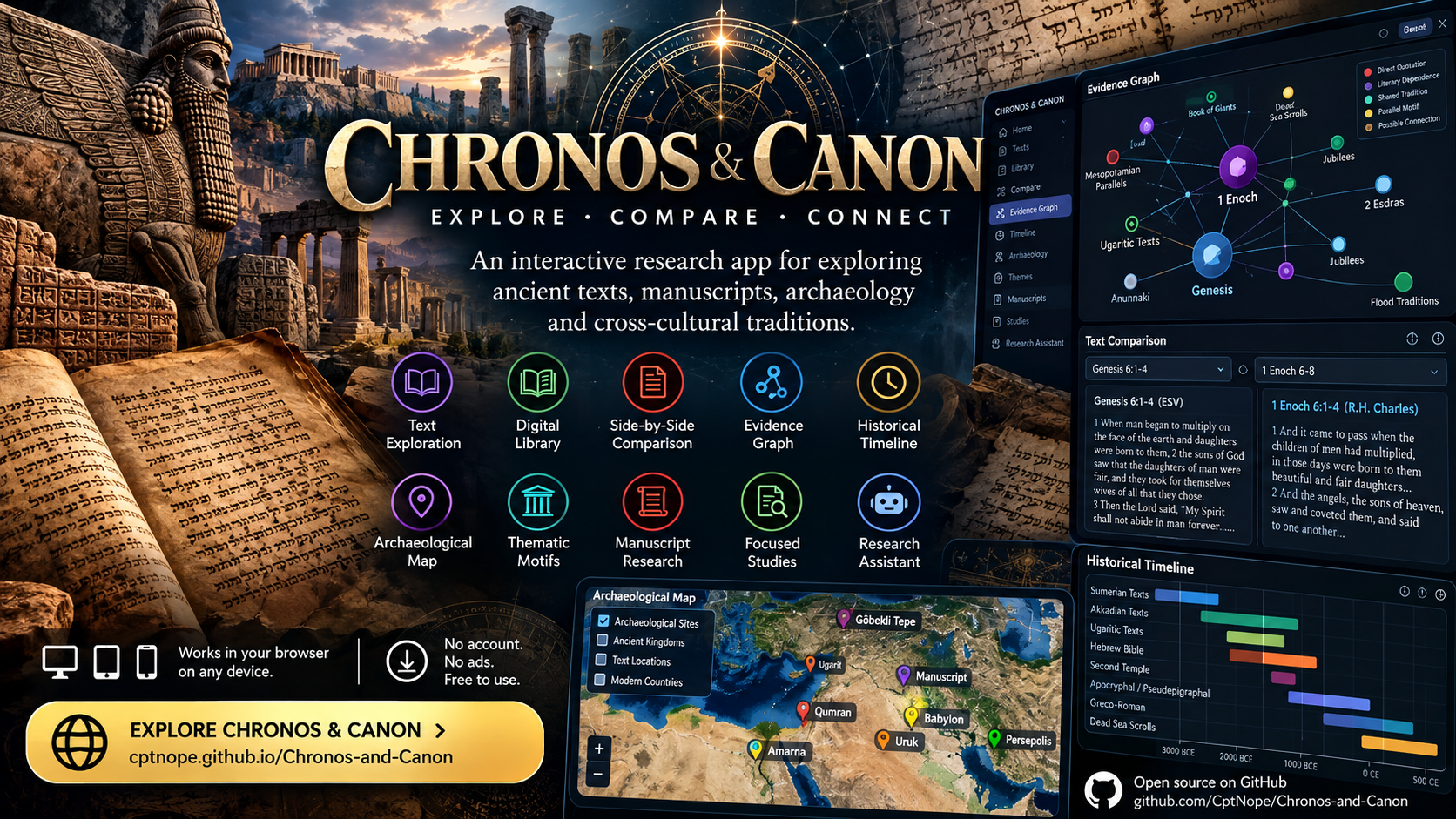
The current application contains 13 interconnected research modules covering text exploration, a digital library, side-by-side comparison, an evidence graph, historical timelines, archaeological mapping, thematic motifs, manuscript research, focused studies, and a research assistant.
Some of the areas I find most interesting include:
- Synoptic text comparison — place ancient passages beside one another and examine language, themes, structure, and historical context.
- Interactive evidence graph — visualize relationships between texts and traditions as a network rather than a flat list.
- Ancient-world timeline — explore texts across thousands of years while distinguishing estimated composition dates from surviving manuscript dates.
- Archaeological map — connect texts with places such as Qumran, Ugarit, Nineveh, Uruk, Elephantine, and Amarna.
- Genesis 6 / Watchers study — examine Genesis, 1 Enoch, the Book of Giants, and proposed Mesopotamian parallels together.
- Flood comparison — compare traditions including Atrahasis, Gilgamesh, Genesis, Berossus, the Shatapatha Brahmana, and the Popol Vuh.
- The “70 Books” study — investigate the strange passage in 2 Esdras 14 describing twenty-four public books and seventy additional books reserved for the wise.
The project also links users toward major public research collections such as the Dead Sea Scrolls Digital Library, British Museum collections, Perseus Digital Library, Sefaria, and other scholarly resources rather than attempting to replace those institutions.
Making the Evidence Visible
One of my favorite parts of the project is the evidence graph.
Ancient literature doesn’t exist in neat independent boxes.
Texts were copied, translated, reinterpreted, preserved, lost, rediscovered, and transmitted across languages and empires. Traditions moved through Mesopotamia, Egypt, Canaan, Persia, Greece, Rome, and beyond.
A traditional article can describe those relationships.
A graph lets you see them.
Texts become nodes, while documented or proposed relationships become connections between them. The strength and type of those relationships can then be represented visually.
The intention is not to imply that every connection proves direct borrowing.
In fact, the opposite is important.
A direct quotation, a likely literary dependency, a regional shared tradition, and a similar motif appearing thousands of miles away are fundamentally different kinds of evidence. Chronos & Canon is designed to keep those distinctions visible rather than collapsing everything into “these stories are the same.”
Genesis 6 Was One of the Starting Points
One rabbit hole behind this project was Genesis 6:1–4.
It’s an unusually short biblical passage considering how much later literature appears to develop ideas surrounding it: the “sons of God,” Nephilim, giants, forbidden knowledge, divine rebellion, and the events preceding the Flood.
Reading Genesis alone gives you only a few verses.
Then you encounter 1 Enoch.
Then the Book of Giants among the Dead Sea Scrolls.
Then references in Jude and 2 Peter.
Then discussions surrounding figures and traditions from Mesopotamia.
Whether all of those materials should ultimately be connected in the same historical reconstruction is a scholarly question — and different proposed connections have very different evidentiary strength.
That is exactly the kind of problem Chronos & Canon was built to explore.
Instead of beginning with a conclusion, the application can put the sources, dates, manuscripts, relationships, and competing levels of evidence in front of the researcher.
The Technology Behind It
Chronos & Canon is also an experiment in how far a modern browser application can go without requiring a traditional server-backed platform.
The frontend is built with React 19, TypeScript, Vite, Tailwind CSS, and Workbox/PWA technology. The core textual, geographical, motif, and relationship datasets are compiled into strongly typed client-side structures, allowing much of the application to operate without an external backend.
It’s deployed through GitHub Pages using GitHub Actions and functions as a Progressive Web App.
That means it can be installed from the browser on desktop, Android, or iOS and can cache application resources for offline use.
I also built a custom update system because PWAs create an interesting problem: aggressive caching is great until users get stuck running an old release.
Chronos & Canon uses both service-worker detection and version polling to determine when a new build exists, allowing users to refresh into the latest release without manually clearing their browser data.
It’s one of those pieces of development work most users will hopefully never think about — which usually means it’s doing its job.
Preserving the Original Languages
Another important part of the project is preserving ancient scripts.
The interface itself can change between English, Spanish, and Portuguese, but original Hebrew, Aramaic, Greek, Ge’ez, and transliterated Akkadian terms remain intact rather than being translated along with the UI.
That matters because sometimes a translation hides the very thing you’re trying to investigate.
Terms such as Nephilim, Bene ha-Elohim, Tehom, Yam, or Apkallu carry linguistic and historical context that can’t always be represented by a single English word.
The application is therefore moving toward something between a visualization platform, digital humanities project, comparative text reader, and research notebook.
This Is an Ongoing Project
Chronos & Canon isn’t meant to be a final declaration about ancient history.
It’s a framework for exploring it.
As I continue developing the project, I want to expand the text corpus, improve manuscript and archaeological sourcing, add more primary-source material, strengthen citations, build additional visualizations, and continue making the distinction between established scholarship and exploratory theories as clear as possible.
Ancient literature gets particularly interesting when you stop looking at individual traditions in isolation.
You begin seeing conversations spanning thousands of years.
Stories are preserved.
Stories change.
Languages borrow from one another.
Empires rise and disappear.
Manuscripts survive in caves, monasteries, libraries, archaeological sites, and clay tablets.
And sometimes a few lines in one ancient document lead you into an enormous network of literature you never knew existed.
That’s what I’m trying to make easier to explore with Chronos & Canon.
Chronos & Canon is free to use and the source code is public.