
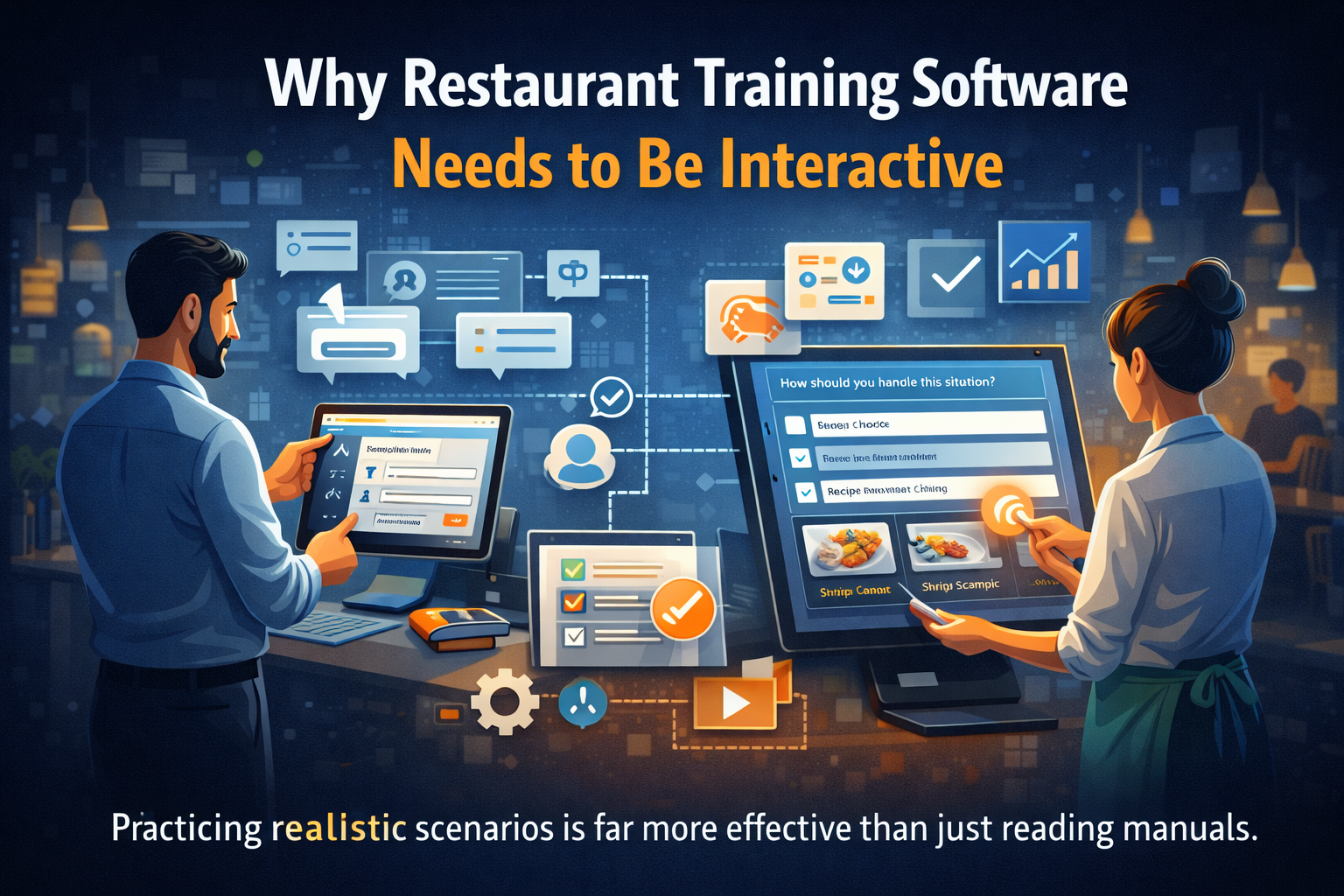
Interactive restaurant training software improves retention, confidence, and performance by allowing staff to practice real-world scenarios instead of passively consuming information. In fast-paced environments, hands-on learning is significantly more effective than manuals or videos alone.
Most restaurant training fails for a simple reason:
It doesn’t match the job.
Restaurant work is fast, physical, and unpredictable.
But most training is slow, passive, and disconnected from reality.
That gap is where problems start.
The Problem With Traditional Restaurant Training
Most restaurant training looks like this:
- Read a training manual
- Watch onboarding videos
- Memorize menus or procedures
- Sign off that training is complete
On paper, it works.
In reality, it doesn’t.
Restaurant staff are expected to:
- Think on their feet
- Read guest behavior
- Handle pressure in real time
Those skills aren’t learned by reading—they’re learned by doing.
Why Passive Training Fails in Restaurants
Traditional training methods are passive.
But restaurant work is:
- Interactive
- Social
- Reactive
That mismatch creates:
- Low retention
- Lack of confidence
- Poor real-world performance
New hires often finish training still feeling unprepared—which leads directly to mistakes and frustration.
What Interactive Restaurant Training Looks Like
Interactive training closes the gap between learning and doing.
Instead of memorizing information, staff actively engage with it.
Key elements include:
Scenario-Based Training
Staff practice real situations:
- Handling guest complaints
- Upselling appropriately
- Managing difficult interactions
AI-Powered Conversations
Tools simulate real guest interactions and adapt responses based on input.
Spaced Repetition Learning
Short, repeated training sessions reinforce knowledge over time instead of overwhelming staff on day one.
Immediate Feedback
Instead of waiting for evaluation:
- Staff get feedback instantly
- Mistakes become learning moments
Real Example: Interactive Menu Training
Instead of handing a new server a long menu packet:
Interactive systems break learning into:
- Small, focused sessions
- Quizzes based on real scenarios
- Adaptive repetition based on weak areas
This builds:
- True menu knowledge
- Faster recall
- Confidence during service
Staff can train:
- Before shifts
- During downtime
- On their phones
Training Soft Skills With AI
The hardest part of restaurant work isn’t the menu.
It’s the people.
Interactive systems can simulate:
- Greeting guests
- Handling complaints
- Managing special requests
- Communicating with teammates
AI-driven training creates branching conversations that adapt in real time—making practice feel much closer to real service environments.
Why This Matters for Retention
Restaurant turnover is one of the biggest operational challenges.
One major reason:
New hires feel unprepared.
When someone:
- Makes mistakes constantly
- Feels behind
- Doesn’t get meaningful feedback
They leave.
Interactive training changes that.
It builds:
- Confidence
- Competence
- Engagement
And confident employees stay longer.
The Business Impact of Interactive Training
Interactive training doesn’t just improve learning—it improves operations.
Restaurants see:
- Faster onboarding
- Better service quality
- Increased upselling performance
- Lower turnover
- More consistent guest experiences
The cost of better training is often far lower than the cost of constant rehiring.
The Shift: From Information to Experience
Restaurant training is evolving:
From:
- Static manuals
- One-time onboarding
To:
- Continuous learning
- Real-world simulation
- AI-assisted coaching
The goal is no longer just to teach information.
It’s to build real-world capability.
Final Thoughts
Interactive training isn’t a “nice to have.”
It’s becoming the standard.
The question isn’t whether it works.
It’s whether your restaurant is ready to move beyond the binder.
FAQ
Why is interactive training better for restaurant staff?
Interactive training is more effective because it allows staff to practice real-world scenarios, improving retention, confidence, and decision-making under pressure.
What is restaurant training software?
Restaurant training software is a digital platform used to teach staff menu knowledge, service skills, and operational procedures through structured and often interactive learning modules.
How does AI improve restaurant training?
AI improves training by simulating real conversations, adapting to user responses, and providing immediate feedback to help staff learn faster and more effectively.
Does interactive training reduce employee turnover?
Yes. Interactive training helps employees feel more confident and prepared, which reduces frustration and increases retention.
What features should restaurant training software include?
- Scenario-based learning
- Mobile accessibility
- Real-time feedback
- Progress tracking
- Adaptive learning systems