Interactive Ancient Text & Archaeology Research Platform
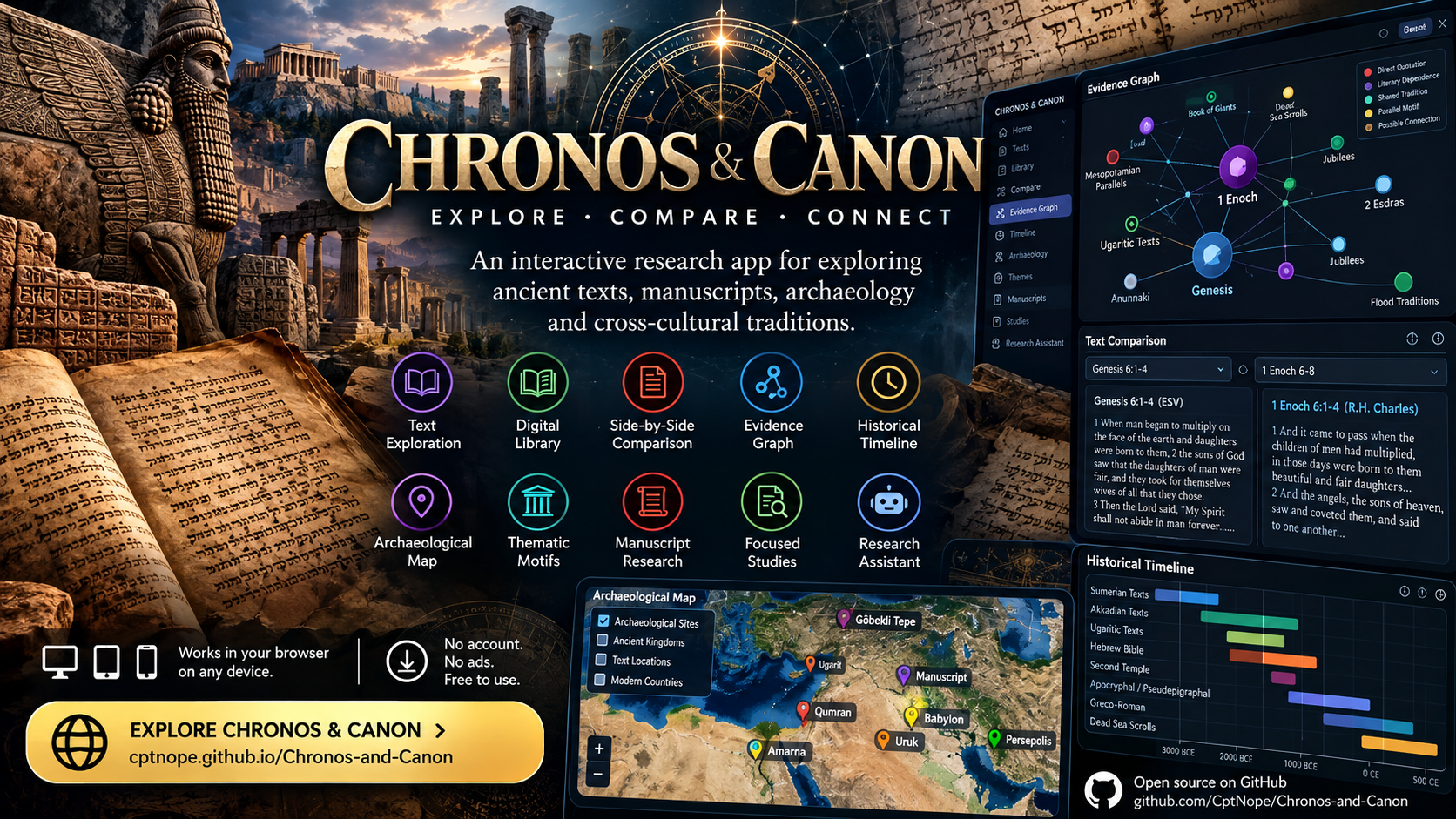
Chronos & Canon is an interactive digital humanities research platform designed to explore relationships between ancient texts, manuscripts, archaeology, historical traditions, and cross-cultural literary motifs.
The project brings material from the Hebrew Bible, Second Temple Jewish literature, Mesopotamian writings, Ugaritic texts, Greco-Roman sources, the Dead Sea Scrolls, apocryphal literature, and related traditions into a single research environment.
Rather than functioning as a simple digital library, Chronos & Canon focuses on visualizing how texts, ideas, manuscripts, locations, and historical periods connect.
Exploring Ancient Texts Differently
Traditional research often requires jumping between books, PDFs, academic websites, manuscript databases, museum collections, and reference works.
Chronos & Canon attempts to make that process more visual and interactive.
Users can compare passages side by side, explore archaeological locations, examine manuscript traditions, navigate historical timelines, and visualize relationships between texts through interactive graphs.
The application is intended as a research tool rather than a system that tells users what conclusions they should reach.
Evidence Matters
One of the most important design decisions in Chronos & Canon is separating different kinds of evidence.
A direct quotation between two texts is not equivalent to a vague similarity between stories.
Likewise, textual dependence, shared regional traditions, parallel motifs, and speculative connections should not all be presented with the same confidence.
Chronos & Canon therefore categorizes relationships according to both their type and evidentiary strength.
Users can explore material using different research modes, including:
- Scholarly
- Comparative
- Exploratory
- Speculative
These modes determine which kinds of relationships are displayed throughout the application.
The goal is to allow broad exploration without presenting every interesting similarity as an established historical connection.
Side-by-Side Text Comparison
The synoptic comparison system allows ancient passages to be displayed next to one another.
This is especially useful when studying material such as:
- Genesis and 1 Enoch
- Genesis and Mesopotamian flood traditions
- Biblical texts and Dead Sea Scroll manuscripts
- Second Temple literature
- Apocryphal and pseudepigraphal works
- Ancient Near Eastern texts
Comparing texts directly can make structural, thematic, and linguistic similarities easier to investigate.
Interactive Evidence Graph
Chronos & Canon includes a network visualization showing relationships between texts and traditions.
Texts appear as connected nodes while relationships between them are represented visually.
The graph can show connections involving concepts such as:
- Direct quotations
- Literary dependence
- Shared traditions
- Parallel motifs
- Proposed relationships
This allows users to explore ancient literature as a network rather than a collection of isolated documents.
Historical Timeline
Ancient texts often become difficult to understand when their chronology is ignored.
Chronos & Canon includes an interactive timeline that places texts, cultures, manuscript traditions, and major historical periods within a broader chronological framework.
The application also distinguishes between concepts such as estimated composition dates and surviving manuscript evidence when appropriate.
That distinction can be particularly important when studying texts that may have circulated for centuries before the manuscripts available today were produced.
Archaeological Mapping
The archaeological map connects textual traditions with physical locations.
Users can explore places associated with manuscripts, civilizations, excavation sites, and ancient literary traditions.
Examples include locations such as:
- Qumran
- Ugarit
- Nineveh
- Babylon
- Uruk
- Amarna
- Persepolis
- Göbekli Tepe
This helps connect literature with geography and historical context.
Genesis 6 and the Watchers
One of the research areas that originally inspired Chronos & Canon was Genesis 6:1–4.
The brief biblical passage concerning the Sons of God, Nephilim, and events preceding the Flood developed into a much larger literary tradition.
Chronos & Canon allows users to explore material involving:
- Genesis
- 1 Enoch
- The Book of Giants
- Dead Sea Scroll manuscripts
- Jude
- 2 Peter
- Related Ancient Near Eastern traditions
Different proposed relationships can then be viewed according to their evidentiary classification.
Ancient Flood Traditions
Another major research area is the comparison of ancient flood narratives.
The application can help explore traditions involving texts such as:
- Genesis
- Atrahasis
- The Epic of Gilgamesh
- Berossus
- Other ancient flood traditions
The goal is not simply to say that these stories are identical.
Instead, users can inspect their chronology, geographic context, themes, similarities, and differences.
Manuscripts and Original Languages
Chronos & Canon also places emphasis on manuscript traditions and original-language material.
The application can preserve Hebrew, Aramaic, Greek, Ge’ez, and transliterated Akkadian material while the surrounding interface is translated.
That makes it possible to support multiple interface languages without losing important linguistic information contained within the source material.
Multilingual Interface
The application currently supports interface localization including:
- English
- Spanish
- Portuguese
Ancient-language content remains intact rather than being translated with the rest of the interface.
Progressive Web App
Chronos & Canon is also built as a Progressive Web App.
Users can install it from the browser and launch it more like a standalone application.
Service-worker caching allows large portions of the application to remain available after the initial load.
A custom update system also helps detect new releases so installed versions do not remain permanently stuck on old cached builds.
Client-Side Architecture
A significant amount of Chronos & Canon runs directly in the browser.
Textual information, geographic information, evidence relationships, motifs, and other structured datasets are compiled into strongly typed application data.
This reduces the need for a traditional backend while keeping the application fast and portable.
Technical Stack
Chronos & Canon uses technologies including:
- React 19
- TypeScript
- Vite
- Progressive Web App APIs
- Workbox
- Data visualization
- Internationalization
- GitHub Actions
- GitHub Pages
- Client-side structured datasets
An Ongoing Research Platform
Chronos & Canon is still growing.
Future development can include additional texts, manuscripts, archaeological evidence, visualizations, citations, historical context, and research tools.
The long-term goal is to create a platform where researchers and curious readers can investigate ancient literature across cultures while keeping the distinction between documented evidence and speculation visible.
Live Application:
https://cptnope.github.io/Chronos-and-Canon/
Source Code:
https://github.com/CptNope/Chronos-and-Canon
Full Case Study:
https://jeremyanderson.tech/i-built-a-powerful-interactive-archive-for-ancient-texts/